
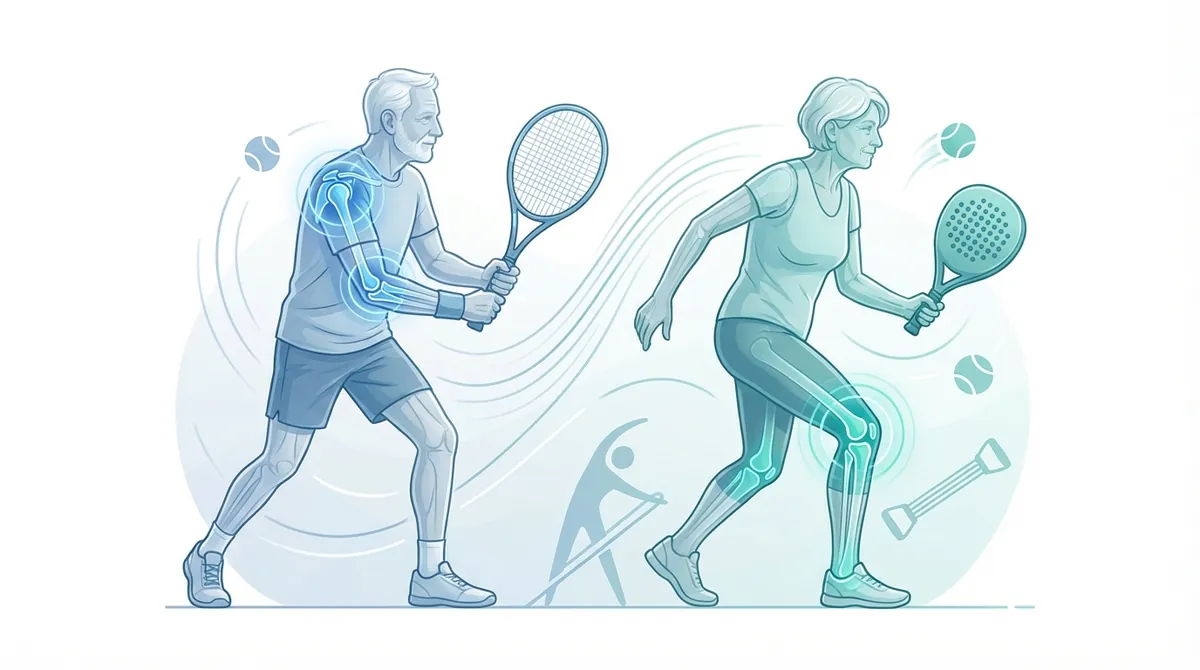
Title: Tennis and Padel Over 50: Frequent Injuries and How to Prevent Them
Frequently Asked Questions
Why are racket sports like tennis and padel becoming so popular for people over 50?
These sports offer significant cardiovascular, metabolic, and psychological benefits, promoting an active lifestyle and socialization. They provide an excellent way to stay fit and engaged within the community.
- Racket sports offer significant cardiovascular, metabolic, and psychological benefits for over 50s.
- Overuse injuries are prevalent in over 50s due to physiological tissue aging and reduced recovery.
- Aging reduces muscle mass, strength, and tendon elasticity, increasing injury susceptibility.
- Consult a healthcare professional for pain; avoid self-diagnosis for effective management.
What kind of injuries are most common for older adults playing tennis or padel?
For individuals over 50, functional overload pathologies, often referred to as overuse injuries, are most prevalent. This is due to physiological tissue aging that reduces the load capacity and recovery times of tendons, muscles, and joints.
How does the aging process specifically affect my body’s susceptibility to injuries in these sports?
After age 50, the body experiences a progressive decrease in muscle mass and strength, reduced water content in intervertebral discs and articular cartilages, and stiffening of tendinous structures. Tendons, in particular, lose elasticity, making them more prone to micro-injuries and chronic tendinopathies.
What should I do if I start experiencing pain while playing tennis or padel?
It is crucial to avoid self-diagnosis and promptly consult your doctor or physical therapist. They can provide an accurate diagnostic framework and establish a personalized therapeutic plan to manage your symptoms effectively.
Why is a preventive approach so important for over 50 racket sport players?
A rigorous preventive approach is essential to ensure sports longevity free from complications and to protect overall health. Injuries can lead to significant temporary work disability and impair daily life, highlighting the broader impact of prevention.
In recent years, there has been an exponential increase in the practice of racket sports, particularly among the adult and senior population. Addressing the topic of tennis padel over 50 means analyzing a sports and social phenomenon of great importance. These disciplines offer countless cardiovascular, metabolic, and psychological benefits, promoting socialization and maintaining an active lifestyle. However, intensive competitive or amateur practice in this age group exposes the musculoskeletal system to significant biomechanical stresses, which require careful clinical and preventive evaluation. The human body, after the fifth decade of life, undergoes physiological tissue aging processes that alter the load capacity and recovery times of tendons, muscles, and joints. Therefore, knowledge of the most frequent pathologies and the adoption of targeted preventive strategies become essential elements to ensure sports longevity free from complications.
International scientific literature highlights how the incidence of injuries in racket sports varies significantly in relation to the practitioner’s age. While acute traumas related to falls or sprains prevail in young athletes, in the over 50 population there is a clear predominance of functional overload pathologies (overuse). This epidemiological change is closely correlated with structural changes in collagen and a reduction in musculotendinous compliance (Smith et al., 2020). It is essential, in case of the onset of painful symptoms, to avoid self-diagnosis and promptly consult your doctor or physical therapist for an accurate diagnostic framework and the setting of a personalized therapeutic plan.
The Impact of Tennis Padel Over 50 on the Musculoskeletal System
The practice of tennis padel over 50 imposes a series of extremely complex biomechanical demands on the human body. Both sports are characterized by explosive movements, sudden accelerations and decelerations (stop-and-go), abrupt changes of direction, and repetitive technical gestures involving the dominant upper limb, trunk, and lower limbs. This combination of factors generates shear, compression, and torsional forces that are exerted on joint structures which, due to age, have a reduced tolerance to mechanical stress.
From a physiological point of view, passing the age of 50 involves a series of alterations affecting the locomotor system. There is a progressive decrease in muscle mass and strength (initial sarcopenia), a reduction in the water content of intervertebral discs and articular cartilages, and a stiffening of tendinous and ligamentous structures. Tendons, in particular, lose some of their elasticity due to an alteration in type I collagen turnover, making them more susceptible to micro-injuries which, if not adequately managed, can evolve into chronic tendinopathies or ruptures (Gomez-Ruiz et al., 2019).
A noteworthy and often underestimated aspect concerns the socio-economic impact of sports injuries in this age group. Data provided by INAIL (National Institute for Insurance against Accidents at Work) regarding sick leave show that traumas resulting from amateur sports activities, particularly in over 50s who are still professionally active, represent a frequent cause of temporary work disability. A knee or shoulder injury, in addition to precluding sports practice, can significantly impair work capacity, especially for those professional categories that require physical effort or the maintenance of prolonged postures. This data underlines the importance of a rigorous preventive approach, which protects not only sports health but also the quality of the individual’s working and daily life.
Furthermore, it is essential to consider the concept of the “kinetic chain”. In tennis and padel, the force needed to hit the ball is not generated exclusively by the arm, but is the result of a complex sequence of muscle activations that starts from the feet, transfers through the legs, pelvis, and trunk, finally reaching the shoulder, elbow, and racket. In over 50 athletes, any deficits in strength or mobility in the lower limbs or core (the abdominal and lumbar corset) lead to an interruption or inefficiency of this kinetic chain. Consequently, the upper limb is forced to compensate for this deficit, undergoing an abnormal overload which is the precursor to numerous inflammatory and degenerative pathologies.
The Most Common Pathologies in Tennis Padel Over 50
The epidemiological analysis of injuries in tennis padel over 50 reveals a specific distribution of pathologies, involving both the upper limb (mainly due to technical hitting gestures) and the lower limb (due to court movements). The clinical conditions most frequently encountered are analyzed in detail below.
Lateral Epicondylitis (Tennis Elbow)
Lateral epicondylitis, commonly known as “tennis elbow”, represents the most iconic and widespread overuse pathology in racket sports. It is an insertional tendinopathy involving the extensor muscles of the wrist and fingers, which originate from the lateral epicondyle of the humerus. Although the suffix “-itis” suggests an acute inflammatory process, histological studies have shown that the condition is primarily characterized by angiofibroblastic degeneration of the tendon tissue (tendinosis), caused by repeated microtrauma and a failure of cellular repair processes (Nirschl et al., 2003).
In tennis, this pathology is often associated with incorrect execution of the backhand, particularly the one-handed backhand, where the impact with the ball occurs with the wrist in an unstabilized extension, transferring the entire impact force to the tendon insertion. In padel, epicondylitis is equally frequent due to the greater weight of the racket (pala), the absence of strings that absorb vibrations, and the frequency of slice shots, which require a strong eccentric contraction of the extensors. Symptoms include sharp pain on the outer side of the elbow, radiating along the forearm, weakness in grip, and difficulty performing daily gestures such as pouring water from a bottle or turning a doorknob. In the presence of such symptoms, it is imperative to suspend activity and consult your doctor or physical therapist to avoid the condition becoming chronic.
Rotator Cuff Injuries and Tendinopathies
The shoulder joint is subjected to extreme stress during overhead shots, such as the serve and smash in tennis, or the bandeja and vibora in padel. The rotator cuff, a complex of four muscles (supraspinatus, infraspinatus, teres minor, and subscapularis) responsible for the dynamic stabilization of the humeral head in the glenoid cavity, is the most at-risk structure. In over 50s, the supraspinatus muscle tendon often shows signs of physiological age-related degeneration, making it vulnerable to partial or total tears.
The biomechanics of the serve or smash requires extreme external rotation and abduction of the shoulder during the loading phase, followed by violent internal rotation and flexion during the impact and follow-through phases. If the scapulothoracic musculature is not adequately strong and coordinated, impingement (subacromial conflict) can occur, where the rotator cuff tendons and the subacromial bursa are compressed between the humeral head and the scapular acromion. Pain typically manifests during arm elevation, associated with weakness and, in more severe cases, nocturnal pain that disturbs sleep.
- Foam roller vibrante (Recupero | 50-90€)
- Compression sleeve (polpaccio/ginocchio) (Compressione | 15-30€)
- Spray ghiaccio istantaneo (Primo soccorso | 8-12€)
Achilles Tendinopathy and Calf Injuries (Tennis Leg)
Rapid movements, jumps, and sudden changes of direction place an enormous load on the gastrocnemius-soleus-Achilles tendon complex. Achilles tendinopathy manifests with pain, swelling, and morning stiffness at the heel or along the body of the tendon. In over 50 athletes, the reduced vascularization of the Achilles tendon, combined with loss of elasticity, significantly increases the risk of acute rupture, a dramatic event that often requires surgical intervention and long months of rehabilitation.
Another typical pathology is the so-called “Tennis Leg”, which is a lesion or tear of the medial gastrocnemius (one of the two muscle bellies of the calf), often at the myotendinous junction. This injury typically occurs during a sudden forward sprint to retrieve a short ball (drop shot). The patient experiences acute and sudden pain in the calf, often described as the sensation of having been hit by a stone or a club, accompanied by immediate functional impairment. In this case too, an ultrasound evaluation prescribed by your doctor or physical therapist is essential to quantify the extent of the damage.
Knee and Spinal Pathologies
The knee is the joint that absorbs most of the ground reaction forces. In over 50s, the presence of degenerative changes in the cartilage (initial osteoarthritis) or menisci is frequent. Torsional movements with the foot fixed on the ground, typical of changes of direction in padel, can cause acute meniscal lesions or exacerbate pre-existing gonarthrosis. Patellofemoral pain syndrome, characterized by anterior knee pain, is another common condition resulting from muscle imbalances between the vastus medialis and vastus lateralis of the quadriceps.
As for the spine, continuous twisting, flexion, and extension movements of the trunk subject the lumbar intervertebral discs and facet joints to asymmetrical stress. Mechanical low back pain is a frequent symptom, often exacerbated by weak core musculature or reduced hip mobility, which forces the lumbar region to compensate with excessive movements. Disc herniations or protrusions can become symptomatic following an incorrectly performed technical gesture or in conditions of muscle fatigue.
| Pathology | Prevalence in Tennis | Prevalence in Padel | Main Biomechanical Mechanism |
|---|---|---|---|
| Lateral Epicondylitis | High (One-handed backhand) | Very High (Racket weight, vibrations, slice shots) | Eccentric overload of wrist extensors |
| Rotator Cuff Injuries | High (Serve, Smash) | High (Bandeja, Vibora, Smash) | Subacromial impingement, repeated microtrauma |
| Tennis Leg (Calf Injury) | High (Long sprints) | Moderate (Short but frequent sprints) | Explosive contraction with ankle in dorsiflexion |
| Low Back Pain / Disc Pathologies | Moderate (Twists during serve) | High (Flexions for low retrievals, twists against glass walls) | Shear and torsional forces on the lumbar spine |
| Patellar/Achilles Tendinopathy | Moderate (Hard surfaces) | High (Continuous jumps, artificial turf) | Overload of the extensor and plantar flexor apparatus |
Risk Factors and Biomechanical Differences Between the Two Sports
Although tennis and padel share the nature of racket sports, they present substantial biomechanical differences that influence the type and frequency of injuries, especially in the over 50 population. Understanding these differences is fundamental for implementing effective preventive strategies.
Tennis is played on a larger court. This implies that movements are characterized by longer sprints and a greater need to cover wide lateral distances. Consequently, the cardiovascular system is subjected to alternating aerobic-anaerobic work, and muscle injuries affecting the hamstrings (thigh flexors) and calves are statistically more probable due to the maximum speeds reached during sprinting.
Padel, on the other hand, is played on a smaller court, enclosed by glass walls and metal grids. The ball is almost always in play, reducing dead times between points. Movements are short, multidirectional, and characterized by continuous braking, changes of direction, and jumps. Interaction with the walls also requires sudden trunk twists and shots performed in positions of poor balance. This translates into greater stress for
Sources and Scientific References
- Dahmen J et al. (2023). Incidence, prevalence and nature of injuries in padel: a systematic review. BMJ Open Sport Exerc Med. 9:e001607. DOI | PubMed
- Rodríguez-Cayetano A et al. (2022). Tennis vs padel: Precompetitive anxiety as a function of gender and competitive level. Front Psychol. 13:1018139. DOI | PubMed
- Armstrong C et al. (2023). A Comparison of Match Load Between Padel and Singles and Doubles Tennis. Int J Sports Physiol Perform. 18:512-522. DOI | PubMed
- Paulauskas R et al. (2025). Padel vs. tennis doubles: a comparison of performance demands and game attributes. Front Sports Act Living. 7:1540424. DOI | PubMed
- Meyer HL et al. (2025). Injuries and overuse injuries in padel tennis: a retrospective epidemiological cross-sectional study of a level 1 trauma center in Germany. J Sports Med Phys Fitness. 65:1363-1370. DOI | PubMed