
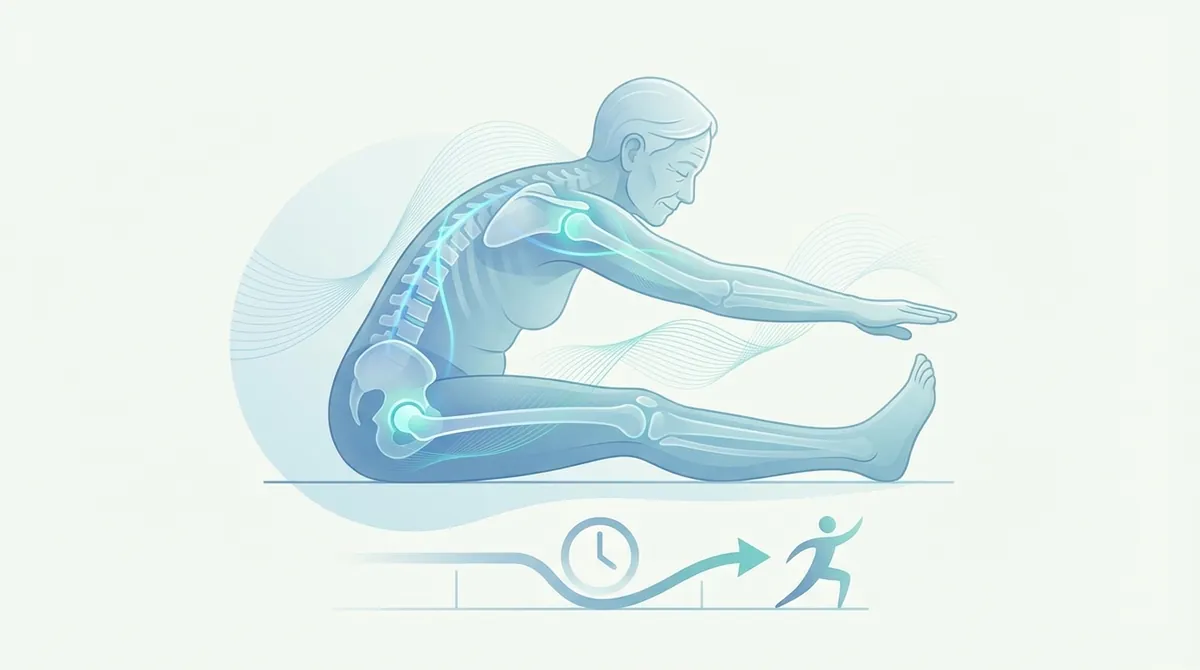
Title: Flexibility After 50: How to Maintain It and Why It’s Never Too Late
Frequently Asked Questions
Why is maintaining flexibility important after age 50?
Maintaining flexibility after 50 is crucial for preserving motor autonomy, reducing the risk of injuries, and improving overall quality of life. It directly counteracts physiological aging processes that stiffen connective tissues, reduce muscle mass, and alter joint lubrication.
- Maintaining flexibility after 50 is crucial for motor autonomy and injury prevention.
- Flexibility can be significantly improved at any age through consistent therapeutic exercise.
- Age-related flexibility decline results from physiological changes and a sedentary lifestyle.
- Regular stretching enhances tissue elasticity, joint lubrication, and muscle compliance.
Is it too late to improve my flexibility if I’m over 50?
No, it is never too late. Scientific literature demonstrates that connective tissue and skeletal muscle maintain a high capacity for plastic adaptation even in advanced age, responding positively to mechanical stimuli from therapeutic exercise. Consistent stretching can significantly improve joint mobility and tissue elasticity.
What causes the decline in joint mobility as we age?
The decline in joint mobility is primarily due to a combination of cellular aging and a sedentary lifestyle. Physiologically, this involves increased cross-links in collagen fibers, decreased elastin synthesis, thinning articular cartilage, reduced synovial fluid production, and adaptive shortening of muscle sarcomeres.
How does regular stretching specifically benefit my musculoskeletal system after 50?
Regular stretching promotes collagen remodeling, stimulates synovial fluid production to lubricate joints, and maintains the physiological length of muscle fibers. This improves musculotendinous compliance, making tissues more capable of absorbing mechanical stress and reducing stiffness, which also aids in injury prevention.
What should I consider before starting a new flexibility program after 50?
It is imperative to approach any new physical activity program with awareness. If you have any pre-existing medical conditions or pathologies, it is strongly recommended to consult a doctor or physical therapist before beginning to ensure a safe and effective approach.
Physiological aging involves a series of inevitable changes affecting the musculoskeletal system, including the progressive loss of connective tissue elasticity, reduction in muscle mass, and alteration of joint lubrication. In this clinical and preventive context, the constant integration of a stretching flexibility over 50 program represents a primary and fundamental intervention to preserve motor autonomy, reduce the risk of injuries, and improve quality of life. Contrary to what one might think, the decline in joint mobility is not an inescapable condemnation linked to age, but rather the result of a combination of cellular aging and, above all, a sedentary lifestyle. Scientific literature widely demonstrates that connective tissue and skeletal muscle maintain a high capacity for plastic adaptation even in advanced age, responding positively to mechanical stimuli provided by therapeutic exercise. However, it is imperative that any approach to physical activity in this age group be undertaken with awareness and, in the presence of pre-existing pathologies, after consulting a doctor or physical therapist.
The Importance of Stretching Flexibility Over 50 for Joint Health
Maintaining an adequate joint range of motion (ROM) becomes a clinical priority after the fifth decade of life. Regular practice of stretching flexibility over 50 directly acts on the physiological mechanisms that regulate mobility, counteracting degenerative processes affecting tendons, ligaments, joint capsules, and muscle bellies.
Physiology of Musculoskeletal Aging
With advancing age, the human body undergoes significant biochemical and structural alterations. At the connective tissue level, there is an increase in cross-links between collagen fibers. This phenomenon, combined with a decrease in elastin synthesis, makes tissues stiffer and less capable of absorbing mechanical stress (Smith et al., 2019). Furthermore, articular cartilage tends to thin, and the production of synovial fluid decreases, increasing friction between bone ends during movement. At the muscular level, the phenomenon of sarcopenia (loss of muscle mass and strength) is often accompanied by an adaptive shortening of sarcomeres, especially in individuals who maintain prolonged static postures. Systematic muscle stretching intervenes in these processes by promoting collagen remodeling, stimulating synovial fluid production through movement, and maintaining the physiological length of myofibrils.
Injury Prevention and Sarcopenia Management
Joint stiffness is one of the main risk factors for musculotendinous injuries and falls in the mature population. A stiff and inelastic muscle is unable to effectively dissipate kinetic energy generated during sudden movements or balance perturbations, transferring the load directly to tendinous and articular structures, with a consequent risk of tears, tendinopathies, or fractures. Flexibility training improves musculotendinous compliance, allowing the system to absorb impacts more efficiently. Furthermore, although stretching does not replace resistance training for the treatment of sarcopenia, it represents an indispensable complement: a muscle that works through its full range of motion is able to generate force more efficiently and recruit a greater number of motor units (Jones & Rose, 2020).
INAIL Data and Impact on Work: Why Maintain Flexibility
The importance of maintaining adequate joint mobility is not exclusively related to leisure or sports, but also has profound implications in the occupational sphere. The extension of working life has led to a significant increase in the average age of the workforce, making the prevention of work-related musculoskeletal disorders (WMSDs) a public health priority.
At-Risk Professional Categories and Biomechanical Overload
According to data provided by INAIL (National Institute for Insurance against Accidents at Work), pathologies of the osteo-muscular system and connective tissue represent the primary cause of reported occupational diseases in Italy. Workers over 50 are particularly vulnerable due to the cumulative effect of repeated microtraumas over the years and the physiological reduction in tissue tolerance to biomechanical load. The most affected categories include healthcare workers (manual handling of loads), construction workers, logistics personnel, and, increasingly, VDU operators, who develop stiffness in the cervical and lumbar spine due to prolonged incongruous postures.
The introduction of flexibility exercise protocols in workplaces or as a daily routine for mature workers has been shown to reduce the incidence of these pathologies. Below is a summary table based on epidemiological evidence relating to musculoskeletal disorders in various job roles for the over 50 age group.
| Professional Category | Main Risk Factors | Most Affected Anatomical Areas | Benefits of Flexibility Exercise |
|---|---|---|---|
| Healthcare Workers / Healthcare Assistants | Manual patient handling, asymmetrical postures | Lumbar spine, shoulders (rotator cuff) | Improvement of lifting biomechanics, reduction of disc compression. |
| Office Workers / VDU Operators | Prolonged static postures, cervical flexion | Cervical spine, cervico-dorsal segment, wrists | Postural rebalancing, reduction of suboccipital and pectoral muscle tension. |
| Construction Workers / Logistics | Lifting loads, vibrations, repetitive movements | Knees, lumbar spine, elbows | Maintenance of tendon elasticity, prevention of insertional tendinopathies. |
| Truck Drivers | Prolonged sitting, whole-body vibrations | Lumbar spine, hips (iliopsoas muscle) | Stretching of hip flexors, spinal decompression. |
Systemic Benefits of Stretching Flexibility Over 50
The implementation of routines aimed at stretching flexibility over 50 produces positive effects that extend far beyond simple muscle lengthening, positively influencing the entire organism and contributing to a holistic health management in mature adults.
Improvement of Posture and Balance
Postural alterations are common after 50 years of age. The tendency towards dorsal hyperkyphosis (rounded back), forward head posture, and anterior pelvic tilt are often the result of muscular imbalances where some muscle groups shorten (e.g., pectoral muscles, hip flexors) and others weaken and lengthen (e.g., rhomboid muscles, hip extensors). A targeted flexibility program allows for the restoration of the correct length of retracted muscles, facilitating the realignment of body segments. Furthermore, correct posture and mobile joints are fundamental prerequisites for good balance. Proprioceptive receptors located in joint capsules and ligaments function optimally only if the joint is free to move within its physiological range. Recent studies indicate that combined flexibility and balance programs significantly reduce the risk of falls in older adults (Johnson et al., 2021).
Reduction of Chronic Pain and Algic Syndromes
Conditions such as chronic low back pain, neck pain, and widespread joint pain affect a large percentage of the over 50 population. Often, these algic syndromes are exacerbated or maintained by chronic muscle tension and spasms. Stretching acts on pain through multiple mechanisms: mechanically, it reduces compression on nerve roots and sensitive joint structures; neurophysiologically, it stimulates mechanoreceptors which, through the “gate control” theory, inhibit the transmission of painful impulses at the spinal cord level. Furthermore, the execution of slow and controlled movements promotes general relaxation and modulation of the autonomic nervous system, reducing the psychosomatic component of pain.
Impact on Circulation and the Nervous System
Muscle stretching promotes local vasodilation, improving the supply of blood, oxygen, and nutrients to peripheral tissues and facilitating the removal of metabolic catabolites. This aspect is particularly relevant for bradytrophic tissues (slow metabolism) such as tendons and ligaments, whose vascularization tends to decrease with age. From a neurological perspective, stretching activates the parasympathetic nervous system, inducing a state of calm, reducing cortisol levels (the stress hormone), and improving sleep quality, a factor often compromised in mature age.
Physiology of Connective Tissue and Response to Stretching
To fully understand the effectiveness of flexibility exercises, it is necessary to analyze the biomechanical behavior of soft tissues. Muscles, tendons, and fascia possess viscoelastic properties. The elastic component allows the tissue to return to its original length after being deformed, while the viscous component causes the tissue to deform permanently (plastic deformation) if subjected to constant and prolonged tension over time. This phenomenon is known as “creep” or viscous flow (Magnusson et al., 2018).
- Set elastici resistenza (5 livelli) (Esercizi | 12-25€)
- Foam roller alta densità (Auto-trattamento | 18-35€)
- Tappetino fitness antiscivolo (Esercizi | 20-40€)
In the over 50 population, the viscous component of tissues changes, requiring longer stretching times to achieve lasting plastic deformation. For this reason, international guidelines suggest that holding times for stretching positions for mature adults should be longer than those recommended for young athletes. Another fundamental physiological phenomenon is the inverse myotatic reflex, mediated by the Golgi tendon organs. When a muscle is stretched and held under tension, these receptors inhibit muscle contraction, allowing for further relaxation and lengthening of the muscle belly.
Recommended Stretching Types for the Over 50 Population
Not all stretching techniques are equal, and the choice of the most appropriate method depends on specific goals, the subject’s clinical conditions, and the time at which the activity is performed. It is always recommended to be guided by a doctor or physical therapist to select the safest techniques.
Static Stretching
It represents the most traditional and safest form of stretching. It consists of bringing a muscle or muscle group to the maximum tolerable degree of stretch (without eliciting acute pain) and holding the position for a determined period of time. This technique is excellent for improving long-term flexibility, reducing post-exercise muscle tone, and promoting relaxation. It is particularly indicated for the over 50 population as it minimizes the risk of activating the stretch reflex (which would cause involuntary muscle contraction) and reduces acute stress on connective tissues.
Dynamic Stretching
It involves active and controlled movements that take joints through their entire range of motion. Unlike ballistic stretching (which uses bounces and rebounds and is strongly discouraged after 50 due to the high risk of injury), dynamic stretching is fluid and progressive. Examples include arm rotations, controlled leg swings, or torso twists. This modality is ideal as a warm-up phase before physical activity (such as walking, swimming, or gardening), as it increases body temperature, lubricates joints, and prepares the neuromuscular system for movement.
PNF (Proprioceptive Neuromuscular Facilitation)
PNF techniques are advanced methods that combine passive stretching with isometric muscle contractions. The most common technique is “Contract-Relax”: the muscle is first passively stretched, then the subject performs an isometric contraction against resistance for a few seconds, followed by relaxation and further passive stretching. This method utilizes neurophysiological mechanisms of autogenic inhibition to achieve rapid and significant flexibility gains. However, requiring a certain body awareness and often the assistance of a practitioner, its execution should initially be supervised by a physical therapist.
| Type | Execution | Ideal Time | Advantages for Over 50s | Risk Level |
|---|---|---|---|---|
| Static | Holding the position for 30-60 seconds. | Post-workout, evening routine, relaxation moments. | Improves tissue length, low joint impact, promotes relaxation. | Very Low |
| Dynamic | Fluid and controlled movements through the full ROM. | Pre-workout, morning warm-up. | Improves joint lubrication, prepares for daily movement. | Low (if performed without bouncing) |
| PNF | Alternation of isometric contraction and stretching. | Specific mobility sessions, rehabilitation. | Maximizes ROM gains by utilizing neurological reflexes. | Medium (requires initial supervision) |
| Ballistic | Rapid, jerky movements with bounces. | Not Recommended | None for this age group. | High (risk of tears and injuries) |
Guidelines for a Safe and Effective Training Program
To obtain tangible benefits and minimize risks, the prescription of flexibility exercise must follow scientifically validated parameters. The American College of Sports Medicine (ACSM) provides specific guidelines for the elderly and mature population, based on the FITT principle (Frequency, Intensity, Time, Type) (Garber et al., 2011).
Frequency, Intensity, Time, and Type (FITT Principle)
- Frequency: It is recommended to perform flexibility exercises at least 2-3 days per week. However, daily practice is considered optimal to counteract morning stiffness and maintain results over time.
- Intensity: The stretch should be perceived as a sensation of “moderate tension” or “slight discomfort,” but should never elicit acute pain, sharp pains, or burning. Pain is an alarm signal indicating potential tissue damage.
- Time (Duration): For adults over 50, research indicates that holding a static stretch for 30-60 seconds is more effective than the classic 15-30 seconds recommended for younger individuals. This prolonged time is necessary to allow aged connective tissue to yield (creep phenomenon). It is recommended to repeat each exercise 2 to 4 times.
- Type: A combination of dynamic stretching for warm-up and static stretching for cool-down and ROM improvement represents the most comprehensive approach.
Warm-up and Cool-down
It is crucial never to perform intense static stretching exercises on “cold” muscles. Before starting a flexibility session, it is advisable to dedicate 5-10 minutes to a light aerobic warm-up (walking in place, stationary bike, gentle joint movements) to increase muscle temperature, making tissues more pliable and less prone to micro-injuries. At the end of the session, movements should be gradually stopped.
Contraindications and Warning Signs (Red Flags)
Although flexibility is beneficial, there are clinical conditions where stretching is contraindicated or requires extreme caution. It is imperative to consult your doctor or physical therapist in the presence of:
- Recent or unhealed fractures.
- Acute inflammation or infections affecting the joints.
- Severe osteoporosis (some twisting movements or extreme spinal flexion can increase the risk of compression fractures).
- Acute and sharp pain during movement.
- Pre-existing joint hypermobility or instability (e.g., recurrent dislocations).
- Recent hematomas or acute muscle trauma (tears).
Practical Flexibility Exercises for the Main Body Areas
Below are some fundamental exercises targeting the body areas that most suffer from stiffness with advancing age. The importance of performing these movements slowly, associating them with deep and regular diaphragmatic breathing, is reiterated. Holding your breath (Valsalva maneuver) increases blood pressure and muscle tension, negating the effects of the exercise. Medical disclaimer: The information in this article is for educational and informational purposes only. It does not replace the advice of a doctor or physiotherapist. For diagnosis and treatment, please consult your trusted doctor or physiotherapist.