
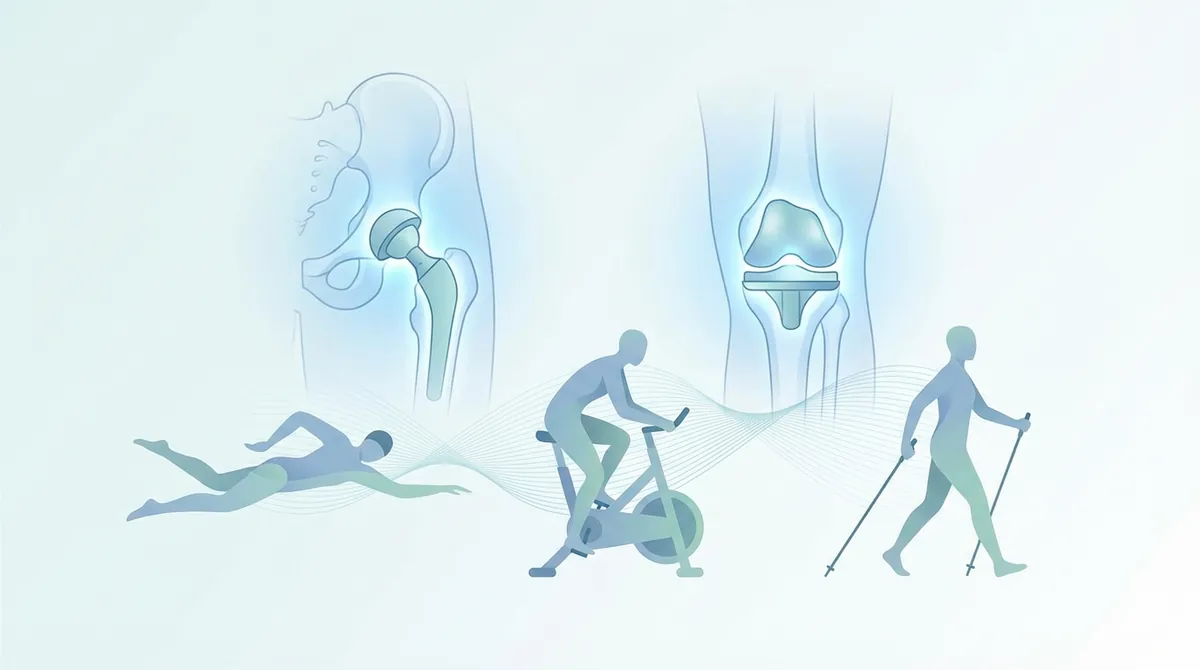
Title: Sport After Hip or Knee Replacement: What You Can and Cannot Do
Resuming sport after hip or knee replacement represents one of the main goals for patients, particularly for the demographic of over 50s, who wish to maintain an active and dynamic lifestyle. Arthroplasty, once considered the end of an individual’s sporting life, is now seen as an opportunity to move again without pain. Thanks to continuous advancements in material science, minimally invasive surgical techniques, and rehabilitation protocols, returning to physical activity is not only possible but widely encouraged by the international medical community. However, this path requires careful planning, a deep understanding of joint biomechanics, and strict adherence to biological healing times. It is crucial to emphasize that each journey is strictly individual and must always be supervised and authorized by your doctor or physical therapist, to avoid early complications or accelerated wear of the prosthetic implant.
- Resuming sport after joint replacement is possible and widely encouraged.
- Advances in surgery, materials, and rehabilitation enable safe return to activity.
- Careful planning and medical supervision are crucial for a successful return.
- Individualized rehabilitation and adherence to healing times are essential.
Severe osteoarthritis, which is the primary cause for prosthesis implantation, leads to progressive functional limitation, muscle atrophy, and altered movement patterns. Surgical intervention resolves the mechanical problem and pain, but restoring muscle function and proprioception requires time and dedication. Modern scientific literature highlights how post-operative inactivity is actually more detrimental to prosthesis longevity than controlled and well-dosed physical activity. Adequate mechanical loading, in fact, promotes bone remodeling around the implant, improving its fixation (a phenomenon known as Wolff’s Law).
The Importance of Resuming Sport After Hip or Knee Replacement
Returning to sport after hip or knee replacement brings countless systemic and local benefits. From a cardiovascular perspective, aerobic exercise reduces the risk of metabolic diseases, hypertension, and heart disease, which often tend to worsen during the months or years of inactivity caused by pre-operative joint pain. From a musculoskeletal perspective, targeted sports activity allows for the recovery of muscle trophism, essential for stabilizing the new joint. Strong muscles act as natural shock absorbers, reducing mechanical stresses transmitted directly to the prosthetic components (Kuster et al., 2000).
Furthermore, the psychological impact should not be underestimated. Returning to sports practice restores a sense of normalcy, self-efficacy, and mental well-being to the patient, counteracting depressive states frequently associated with chronic pain and loss of autonomy. However, the choice of sport must be the result of careful clinical evaluation. International guidelines suggest prioritizing low-impact activities that ensure fluid and continuous movement without overloading the bone-prosthesis interface with excessive force peaks. The final decision on permitted activities rests in any case with the orthopedic surgeon and your doctor or physical therapist, who will evaluate factors such as age, body weight, pre-operative activity level, and the specific surgical technique used.
Recovery Times for Sport After Hip or Knee Replacement
The timing for returning to sport after hip or knee replacement is not universal but follows precise phases of biological healing and functional recovery. Rushing the process exposes the patient to severe risks, including implant dislocation (particularly in the hip), periprosthetic fractures, tendinitis, or early fixation failure. The rehabilitation protocol must be progressive and constantly monitored by your doctor or physical therapist.
Acute and Sub-acute Phase (0-6 weeks)
In this initial phase, the primary goal is pain control, edema reduction, prevention of thromboembolic complications, and recovery of basic range of motion (ROM). Sports activity is strictly precluded. The patient is instructed to perform isometric exercises, assisted active mobilizations, and to resume ambulation with the aid of crutches. The healing of soft tissues (muscles, tendons, joint capsule) incised during surgery requires time. Any excessive mechanical stress in this phase can compromise joint stability. Hydrokinesitherapy (water rehabilitation) can only be introduced after complete healing of the surgical wound, usually around the third or fourth week, with prior medical authorization.
Intermediate Strengthening Phase (6-12 weeks)
Once the acute phase is over, the focus shifts to progressive muscle strengthening, improving balance, and definitively discontinuing walking aids. During this period, your doctor or physical therapist may introduce very low-impact activities such as stationary cycling, which is excellent for improving joint mobility and muscle endurance without applying full axial load. Swimming (freestyle or backstroke, temporarily avoiding breaststroke for knee and hip prostheses due to torsional stresses) and walking on flat, regular surfaces also become an integral part of the recovery program. Proprioception, the nervous system’s ability to perceive the joint’s position in space, is intensely trained to prevent falls.
Advanced Phase and Return to Sport (3-6 months and beyond)
The actual return to sports practice generally occurs no earlier than the third to sixth month post-operatively, provided that the patient has recovered muscle strength of at least 85-90% compared to the healthy contralateral limb, full and painless joint range of motion, and excellent neuromuscular control. In this phase, specific technical movements of the chosen sport are gradually reintroduced. It is essential that the resumption is incremental: starting with short, low-intensity sessions, progressively increasing the workload based on the joint’s clinical response. The appearance of persistent pain or swelling should be interpreted as a sign of overload, requiring immediate re-evaluation by your doctor or physical therapist.
Classification of Sports: Impact and Biomechanical Risk
Orthopedic literature classifies sports activities based on the mechanical impact they generate on weight-bearing joints. Ground reaction forces during running, for example, can reach values of 3-4 times body weight, transmitting extreme stresses to the interface between the bone and the prosthesis. In contrast, sports like swimming or cycling eliminate or drastically reduce these forces. A reference study (Healy et al., 2008) established consensus guidelines among orthopedic surgeons regarding recommended, permitted with prior experience, and discouraged activities.
| Impact Category | Examples of Sports | General Recommendation | Biomechanical Notes |
|---|---|---|---|
| Low Impact | Swimming, Cycling, Golf, Walking, Sailing, Ballroom dancing | Highly Recommended | Fluid movements, reduced axial load, low risk of direct trauma or torsion. |
| Medium Impact | Tennis (doubles), Cross-country skiing, Hiking, Bowling, Rowing | Permitted with experience and caution | Require good muscular preparation. Possible moderate torsional stresses. To be evaluated on a case-by-case basis. |
| High Impact | Running, Soccer, Basketball, Volleyball, Alpine skiing, Tennis (singles), Combat sports | Generally Discouraged | High peak loads, sudden changes of direction, high risk of early wear, dislocation, or fracture. |
Low-Impact Sports (Highly Recommended)
These activities represent the gold standard for prosthesis wearers. **Cycling** (both indoor and outdoor) is excellent for the knee and hip, as it promotes joint lubrication and quadriceps strengthening without ground impact. It is recommended to correctly adjust the saddle height to avoid excessive flexion. **Swimming** is equally beneficial, utilizing the principle of buoyancy to offload body weight. **Golf** is widely practiced by prosthesis wearers; however, it is advisable to use shoes without rigid spikes to allow slight foot rotation during the swing, reducing torsional forces transmitted to the knee or hip. **Brisk walking** (fitwalking) or Nordic walking are excellent alternatives to running, ensuring excellent cardiovascular training.
Medium-Impact Sports (Permitted with Reservations)
Medium-impact sports can be resumed, but generally only if the patient already possessed good technique and familiarity with the discipline before the surgery. Learning a new medium-impact sport after a prosthesis is discouraged due to the risk of uncoordinated movements. **Doubles tennis** is preferable to singles, as it halves the court area to cover and reduces sudden sprints. **Cross-country skiing** is an excellent aerobic activity with linear movements, while **hiking** (trekking) requires caution, especially downhill, where the knee undergoes significant compression loads; the use of telescopic poles is strongly recommended to offload up to 20% of body weight from the lower joints. Before undertaking these activities, consultation with your doctor or physical therapist is mandatory.
High-Impact Sports (Generally Discouraged)
Activities involving running, jumping, sudden changes of direction (pivoting), and physical contact are discouraged by most international orthopedic societies. Sports such as **soccer, basketball, rugby, and long-distance running** generate shear and compression forces that can drastically accelerate the wear of the polyethylene insert of the prosthesis or cause aseptic loosening of the implant. **Alpine skiing** carries an intrinsic risk of high-speed falls and severe torsional trauma; it is sometimes permitted only for experienced skiers, on well-groomed slopes, avoiding fresh snow or ice, and always under strict clinical supervision. The choice to engage in high-impact sports exposes the patient to a calculated risk of needing a prosthetic revision surgery much sooner than average.
Biomechanical Differences: Hip Prosthesis vs. Knee Prosthesis
Although the general principles of returning to sport are similar, there are substantial biomechanical and surgical differences between hip and knee arthroplasty that influence specific recommendations.
Considerations for Hip Prosthesis
The main risk associated with total hip arthroplasty (THA) during sports activity is dislocation, i.e., the prosthetic head coming out of the acetabular cup. This risk is closely linked to the surgical approach used. The postero-lateral approach, traditionally very common, requires caution in combined movements of flexion beyond 90 degrees, adduction, and internal rotation. The direct anterior approach, being “muscle-sparing,” ensures greater early intrinsic stability and reduces the risk of dislocation, allowing a faster return to some activities. In sports like yoga or gymnastics, extreme positions should be avoided or modified. Furthermore, modern materials, such as ceramic-on-ceramic or ceramic-on-highly cross-linked polyethylene bearings, have significantly reduced the problem of wear, allowing patients to maintain higher activity levels than in the past (Kurtz et al., 2011).
Considerations for Knee Prosthesis
Total knee arthroplasty (TKA) presents different challenges. The knee is a complex joint that performs not only flexion-extension movements but also rolling and gliding. Restoring natural kinematics is difficult. The main problem in sport after TKA is not so much dislocation, but rather the wear of the polyethylene insert and overloading of the extensor mechanism (patellar tendon and quadriceps). Activities requiring deep flexion under load (such as heavy weightlifting with deep squats) or repetitive impacts (running) are particularly detrimental. Furthermore, many patients report a sensation of a “mechanical knee” or noises (clicks) during movement, which are normal but can alter perception during athletic gestures. Recovery of proprioception is vital to prevent sudden collapses during sports practice.
INAIL Data: Joint Wear, Professional Categories, and Sport
A fundamental aspect, often overlooked in the evaluation of returning to sport, is the interaction between the patient’s work activity and recreational activity. Data provided by INAIL (National Institute for Insurance against Accidents at Work) highlight how certain professional categories are exposed to a significantly higher risk of developing biomechanical overload pathologies, which often result in the need for prosthetic surgery.
Workers employed in construction, agriculture, logistics (manual handling of loads), and floor layers (subject to prolonged kneeling postures) accumulate a “cumulative load” on their joints over the years. INAIL recognizes specific occupational diseases related to these tasks. When a patient belonging to these professional categories receives a hip or knee prosthesis and wishes to return to work, the implant will already be subjected to significant daily mechanical stresses related to their profession.
In these scenarios, the choice of sport becomes even more critical. If the prosthesis is already stressed for 8 hours a day by heavy work, adding a medium or high-impact sports activity could unacceptably accelerate material wear or the risk of aseptic loosening. For these patients, your doctor or physical therapist will need to structure a sports program exclusively of low impact (such as swimming or cycling on flat terrain), which serves as relief and postural compensation, rather than an additional source of mechanical stress. Ergonomic evaluation of the workplace, combined with an intelligent sports choice, is key to maximizing the survival of the prosthetic implant.
The Crucial Role of Rehabilitation and Proprioception
The success of returning to physical activity depends not only on the technical perfection of the surgical intervention but largely on the quality of the rehabilitation pathway. Physiotherapy is not limited to recovering strength and movement but must reprogram the neuromotor system. Proprioceptive receptors, located in the ligaments and joint capsules, are inevitably damaged or removed during arthroplasty.
This sensory deficit leads to a reduced ability of the body to perceive the limb’s position in space and to react promptly to sudden disturbances (such as stepping on a stone during a hike). The rehabilitation program structured by your doctor or physical therapist must include specific exercises on unstable platforms (Freeman boards, proprioceptive cushions), closed kinetic chain training, and simulations of sports-specific technical movements in a controlled environment. Only when the patient demonstrates automatic and adequate balance reactions can a return to the playing field or track be considered safe.
Practical Advice for a Safe Return to Physical Activity
To ensure that sports resumption occurs in total safety and with maximum benefit, it is necessary to follow some golden rules, based on clinical evidence and biomechanical common sense:
- Extended warm-up: Prosthetic joints and surrounding tissues require more time to prepare for exertion. A warm-up of at least 15-20 minutes, including gentle joint mobility and progressive muscle activation, is mandatory.
- Appropriate equipment: The use of high-quality sports footwear, equipped with excellent cushioning systems, is essential to dissipate impact forces before they reach the prosthesis. In cycling, correct biomechanical calibration of the bicycle (bike fitting) prevents tendinitis and overloads.
- Listen to your body: Pain is the main warning sign. Mild post-workout muscle soreness is normal, but acute, sharp pain or persistent joint swelling indicates that the implant’s tolerance limit has been exceeded.
- Body weight control: Every kilogram of excess weight multiplies by three or four times in terms of load on the hip or knee during ambulation. Maintaining a normal Body Mass Index (BMI) is the most effective strategy to prolong the life of the prosthesis.
- Regular follow-ups: Even in the absence of symptoms, it is imperative to undergo periodic clinical and radiographic check-ups. Only the orthopedic surgeon can assess the state of material wear or early signs of loosening not yet perceptible by the patient.
In conclusion, joint replacement should not be seen as a limitation, but as a new beginning. Medical science strongly encourages movement, provided it occurs with respect for biomechanics and physiological timings. Continuous collaboration with your doctor or physical therapist remains the cornerstone for a safe, rewarding, and long-lasting return to sport.
Frequently Asked Questions (FAQ)
Below are the answers to the most common questions asked by patients regarding the resumption of physical activities after joint replacement surgery.
1. Can I return to running after a hip or knee replacement?
Running is considered a high-impact sport. The forces generated during running can accelerate the wear of prosthetic components or cause implant loosening. Although some patients do resume running, most orthopedic guidelines strongly advise against it. Low-impact alternatives such as brisk walking, swimming, or cycling are suggested. It is essential to consult your doctor or physical therapist for a personalized evaluation.
2. How long do I have to wait before I can swim?
Swimming is an excellent post-operative activity. However, it is necessary to wait for the complete healing of the surgical wound to avoid the risk of infection, which usually takes 3 to 4 weeks. Initially, freestyle and backstroke are recommended. Breaststroke, which places significant torsional stress on the knees and hips, should be avoided in the early stages and reintroduced only after several months and with prior medical authorization.
3. Is cycling safe for my new joint?
Yes, cycling is one of the most recommended activities. As a closed kinetic chain and low-impact sport, it allows for strengthening the leg muscles (particularly the quadriceps) without overloading the joint with body weight. It is advisable to start with a stationary bike (exercise bike) and then move to road cycling, paying close attention to avoiding falls. The saddle must be adjusted to an appropriate height to prevent excessive joint flexion.
4. Is it possible to return to skiing after surgery?
Alpine skiing is a high-risk sport due to possible falls, high speeds, and extreme torsional forces. Generally, it is only permitted for skiers who already had an advanced level of experience before the surgery. It is recommended to ski only on well-groomed slopes, in conditions of excellent visibility and compact snow, avoiding fresh or icy snow. Learning to ski from scratch after a prosthesis is strongly discouraged. The final decision must always be made in agreement with the orthopedic surgeon.
5. Can I do weightlifting at the gym?
Resistance training is fundamental for maintaining muscle trophism but must be adapted. It is recommended to avoid maximal loads and to favor a higher number of repetitions with moderate weights. Exercises such as deep squats (beyond 90 degrees of flexion) or leg presses with high loads can generate excessive pressure on the prosthesis and should be avoided or modified under the strict supervision of your doctor or physical therapist.
Recommended Products for Rehabilitation Support
Product links are affiliate links: purchasing does not incur additional costs for the user. These products do not replace the advice of your doctor or physical therapist.
Frequently Asked Questions
Is it generally safe to return to sport after hip or knee replacement?
Returning to sport after hip or knee replacement is generally possible and widely encouraged by the international medical community. Continuous advancements in surgical techniques, material science, and rehabilitation protocols have made it safer to resume physical activity.
What factors are crucial for a successful return to sport post-arthroplasty?
A successful return requires careful planning, a deep understanding of joint biomechanics, and strict adherence to biological healing times. Each patient’s journey is strictly individual and must always be supervised and authorized by a doctor or physical therapist.
How does controlled physical activity impact the longevity of a prosthetic implant?
Controlled and well-dosed physical activity is considered beneficial for prosthesis longevity, as post-operative inactivity can be more detrimental. Adequate mechanical loading promotes bone remodeling around the implant, which can improve its fixation according to Wolff’s Law.
What is the role of medical professionals in guiding a patient’s return to sport?
Medical professionals, including doctors and physical therapists, play a crucial role in supervising and authorizing a patient’s return to sport. Their guidance ensures careful planning and adherence to individualized rehabilitation protocols, minimizing risks of early complications or accelerated implant wear.
Sources and Scientific References
- Müller, S., et al. Return to sport after total hip arthroplasty: a systematic review. Arch Orthop Trauma Surg. 2021;14
Sources and Scientific References
- Groot L et al. (2022). Recovery and the use of postoperative physical therapy after total hip or knee replacement. BMC Musculoskelet Disord. 23:666. DOI | PubMed
- Chen X et al. (2021). Effects of progressive resistance training for early postoperative fast-track total hip or knee arthroplasty: A systematic review and meta-analysis. Asian J Surg. 44:1245-1253. DOI | PubMed
- Domínguez-Navarro F et al. (2018). Effects of balance and proprioceptive training on total hip and knee replacement rehabilitation: A systematic review and meta-analysis. Gait Posture. 62:68-74. DOI | PubMed
- Ouendi N et al. (2024). Effectiveness of Telerehabilitation Programs in Elderly with Hip or Knee Arthroplasty: A Systematic Review. Telemed J E Health. 30:1507-1521. DOI | PubMed